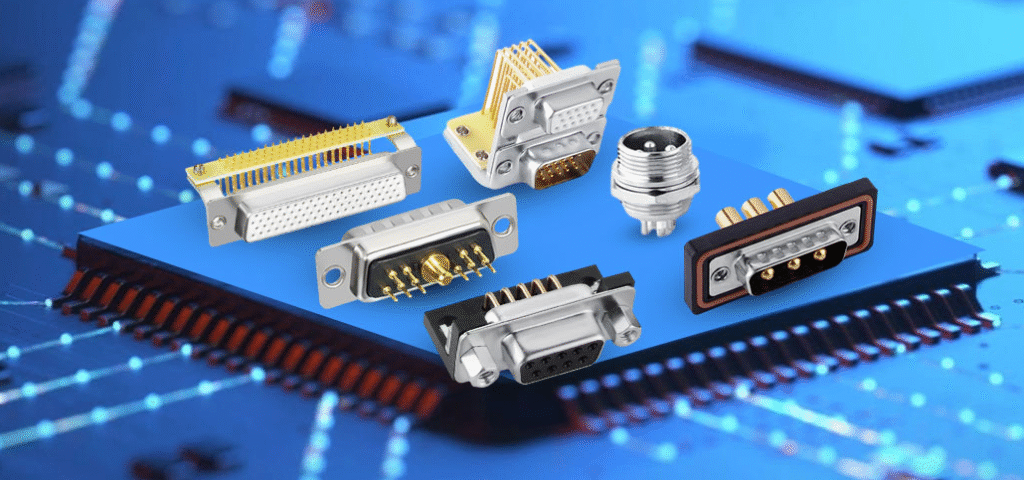
High-Frequency Signal Selection in Industrial Applications
High-frequency signal transmission plays a critical role in modern industrial systems, especially in communication equipment, test and measurement instruments, and automated control systems. Selecting the right D-Sub connector is essential to ensure signal integrity, reduce interference, and maintain stable system performance.
This article explains the key factors to consider when choosing a D-Sub connector for high-frequency signal applications, helping engineers and procurement teams make informed decisions.
What Is High-Frequency Signal Requirement?
High-frequency signals typically refer to signals with frequencies ranging from tens of megahertz (MHz) to several gigahertz (GHz). At these frequencies, signal transmission becomes more sensitive to impedance mismatch, crosstalk, attenuation, and electromagnetic interference (EMI).
For high-frequency applications, connectors must provide controlled impedance, stable electrical performance, and effective shielding. Even minor design flaws in connectors or cables can lead to signal loss or distortion, affecting overall system reliability.
Limitations of Standard D-Sub Connectors
Standard D-Sub connectors are primarily designed for low to medium frequency signal transmission. Their traditional pin layout and unshielded signal paths may introduce crosstalk and impedance discontinuities when used in high-frequency environments.
As signal frequency increases, standard D-Sub connectors may experience higher insertion loss and reduced signal integrity. For this reason, conventional D-Sub connectors are not always suitable for applications requiring precise high-frequency performance.
When to Choose Coaxial D-Sub Connectors
Coaxial D-Sub connectors are specifically designed to support high-frequency signal transmission. By integrating coaxial contacts into the D-Sub housing, these connectors maintain consistent impedance and significantly reduce signal loss.
They are commonly used in applications such as RF communication, data acquisition systems, and test equipment, where high-frequency signal stability is essential. When signal integrity and frequency performance are critical, coaxial D-Sub connectors provide a reliable solution.
Shielding and Impedance Considerations
Effective shielding is essential for minimizing electromagnetic interference in high-frequency applications. High-quality D-Sub connectors often incorporate metal shells, grounding features, and shielded contacts to protect signal paths from external noise.
Impedance matching between the connector, cable, and system is equally important. Maintaining consistent impedance throughout the signal path helps reduce reflections and ensures optimal signal transmission performance.
Custom Cable Assembly Advantages
Custom cable assemblies play a vital role in high-frequency signal applications. By optimizing cable length, connector configuration, and shielding design, custom solutions can significantly improve signal integrity and system reliability.
Custom D-Sub cable assemblies also allow manufacturers to tailor solutions according to specific application requirements, including frequency range, mechanical constraints, and environmental conditions. This flexibility makes custom assemblies an ideal choice for complex industrial systems.
Conclusion
Choosing the right D-Sub connector for high-frequency signals requires careful evaluation of signal requirements, connector design, and system-level performance. While standard D-Sub connectors may be sufficient for low-frequency applications, coaxial D-Sub connectors and custom cable assemblies offer clear advantages for high-frequency signal transmission.
By understanding these factors, industrial users can achieve reliable, high-performance signal connections tailored to their specific needs.